Leads, Quotes & Customers
A leads pipeline from website enquiry to quote to booking, with a reusable quote calculator — distance, vehicle type, and the business's own pricing formula, fuel surcharge included.
A connected CRM, dispatch board, driver app, and customer tracking page for a UK temperature-controlled courier — leads through delivery, on one shared system instead of phone calls, email, WhatsApp, and spreadsheets.
Private client project — shared here with permission.
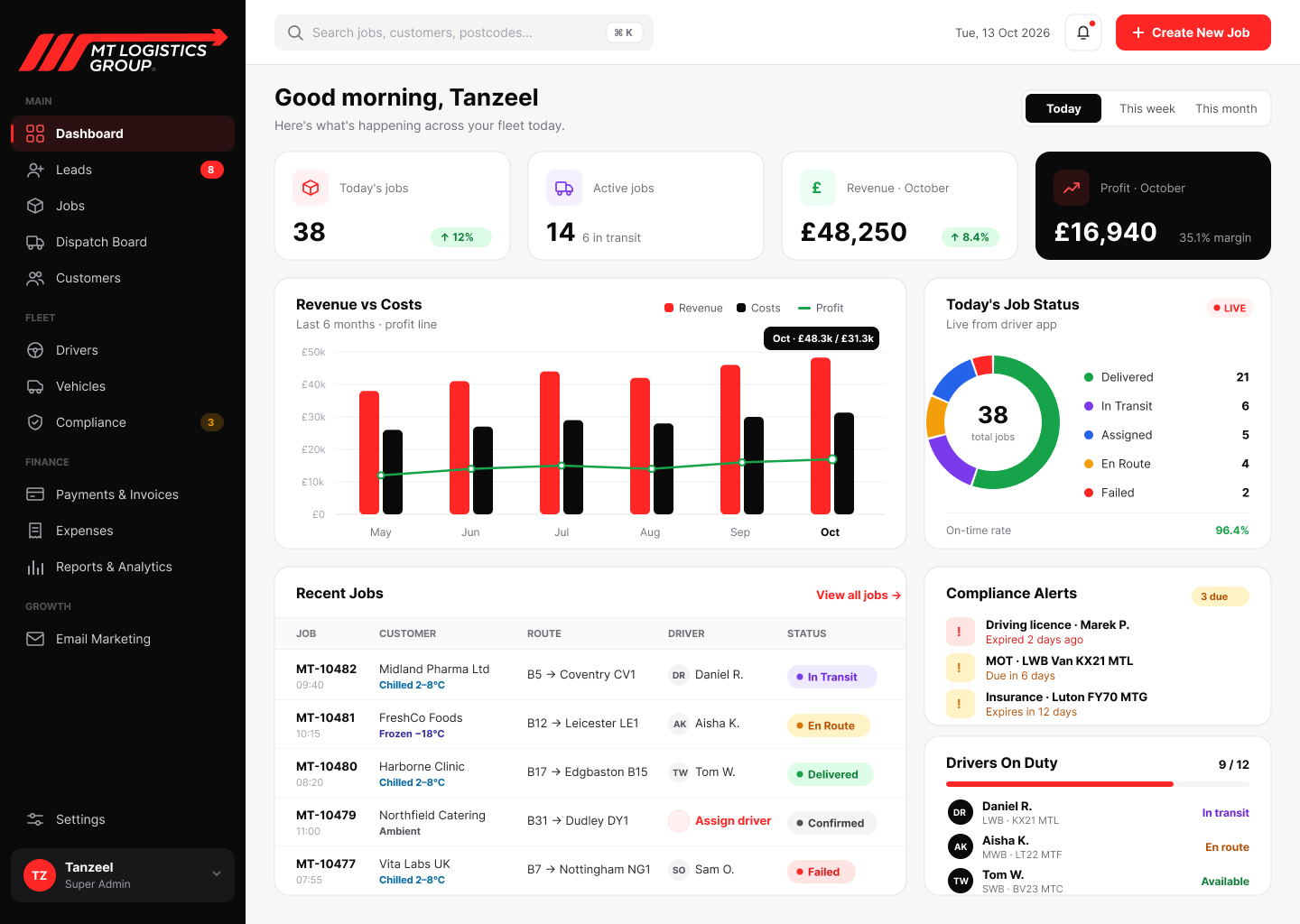
A courier business lives or dies on whether a job actually gets where it's going, on time, with proof it happened. MT Logistics Group CRM is being built as one connected platform covering the whole flow: a lead turns into a quote, a quote becomes a booking, a dispatcher assigns a driver and vehicle, the driver collects and delivers with proof at every stop, and the customer can watch it happen on a live tracking link — all backed by one API and one database, not a patchwork of tools that have to agree with each other.
I'm building the whole system — the web CRM for the office, the driver app for the road, the public tracking page for customers, and the API and real-time layer underneath all three.
Before this build, the business ran entirely on phone, email, WhatsApp, and spreadsheets — leads tracked in someone's inbox, jobs assigned by phone call, proof of delivery as a photo texted to the office, and no single place to see what was actually happening across the fleet on a given day. That works at a small scale and breaks down fast as job volume grows: nothing was connected, nothing updated the customer automatically, and reporting meant someone manually reconciling numbers at the end of the month.
The system is a pnpm/Turborepo monorepo — a React web CRM for the office, a bare React Native driver app (no Expo, for full native-module control over background location and the camera), a Node.js/Express API with Prisma and PostgreSQL, and Socket.IO pushing live updates to every screen that needs them, from the dispatch map to the customer's tracking page.
The real design decision underneath it all: every job supports one pickup and any number of drop-offs, not a single-stop assumption with multi-drop wedged in afterward. The dispatch map draws the whole route before a driver is even assigned, the driver app tracks "stop 3 of 5" with its own status and proof of delivery per stop, and a job can be partially delivered without blocking the stops that succeeded. Permissions are enforced in the API itself for five distinct roles — Super Admin, Support, Dispatcher, Driver, and Customer — not just hidden behind buttons in the UI.
A leads pipeline from website enquiry to quote to booking, with a reusable quote calculator — distance, vehicle type, and the business's own pricing formula, fuel surcharge included.
A live map of unassigned jobs and drivers, with a best-match suggestion by distance and ETA, built for 1..N drop-offs on every job, not just a single destination.
Shift start with an odometer photo, per-stop status updates, and proof of delivery — signature, photos, and temperature logging for chilled and frozen loads — queued offline when signal drops.
A no-login tracking link per job, and a separate link per stop on a multi-drop job, showing live driver location, ETA, and proof of delivery once it's complete.
Stripe-hosted payment links and bulk/consolidated invoicing, alongside a compliance tracker for driver and vehicle documents — licences, MOT, insurance — with reminders before anything expires.
A bidding-platform integration so the business can source and win loads from a haulage exchange marketplace directly inside the same dispatch system, instead of a separate standalone tool.
Every status change — a job assigned, a stop delivered, a payment recorded — pushes live over Socket.IO to the dispatch board, the job page, and the customer's tracking link, instead of anyone having to refresh to find out what's happening. Every mutating action writes an activity log entry, exportable for a real audit trail, and the permission matrix is enforced in the API itself per role, not just hidden in the UI — a Driver's own app is scoped to their assigned jobs only, enforced server-side, not by trusting the client.
The CRM, multi-drop dispatch, driver app, live tracking, payments, compliance tracking, reporting, route optimisation, and the carrier bidding integration are all built and running on staging. The project is now in its pre-launch milestone: a full requirements audit against the signed scope, production-readiness hardening, and handover — before it goes live for the client's own team.
Tell me how your team currently tracks drivers, jobs, and deliveries — I'll tell you honestly whether a custom system is worth it for you.
Start a Project